
Radon Mitigation in Lubbock, TX
How active soil depressurization actually lowers radon, and what a proper quote from an independent Lubbock pro should include.
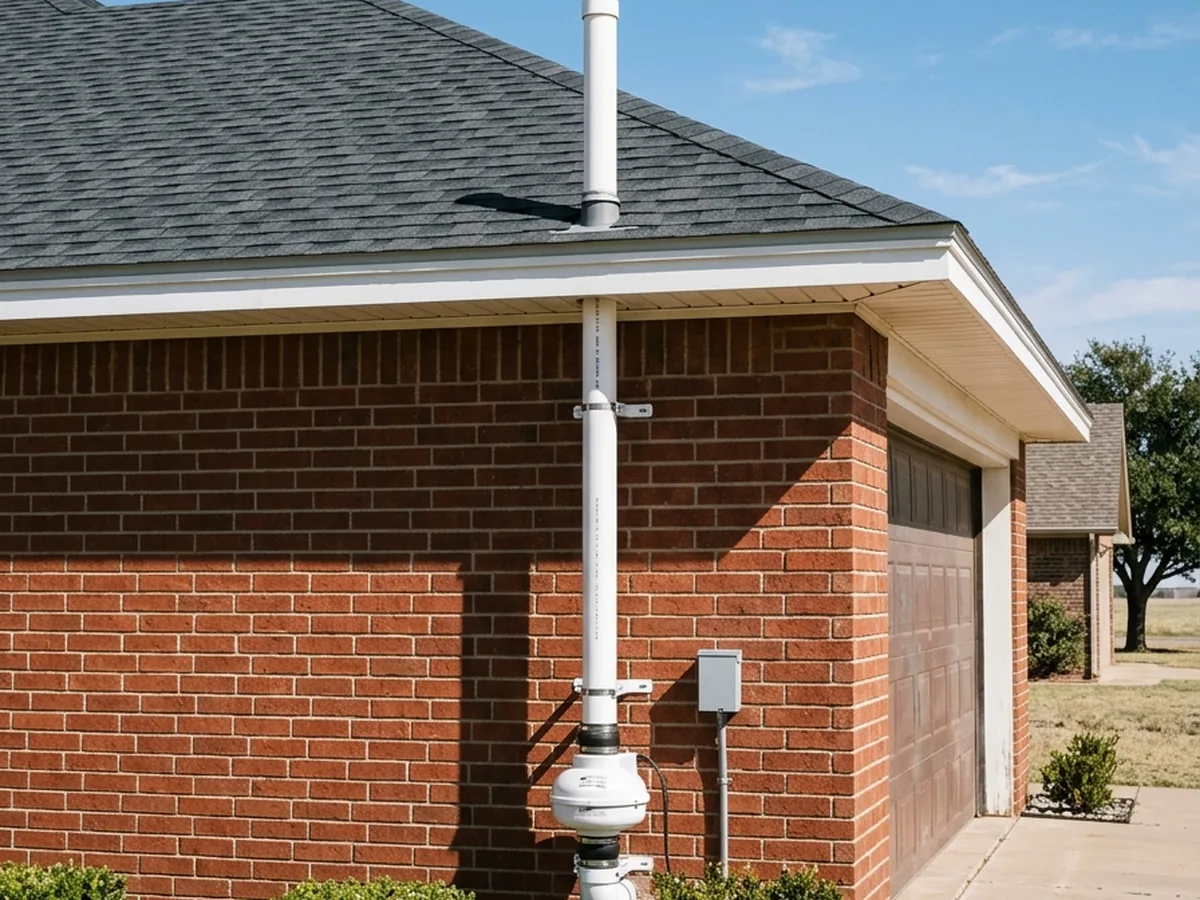
Radon mitigation almost always means active soil depressurization, or ASD. A pro cuts one suction point through the slab (or seals a vapor membrane over a dirt crawlspace), runs PVC pipe from that point up through the house and above the roofline, and attaches an inline fan that continuously pulls soil gas out from under the home before it can seep in. A manometer (a small gauge on the pipe) confirms the system is under active suction. A proper quote covers the system, any sealing the house needs, a post-install retest, and clear warranty terms, the full scope beyond just a fan and a pipe. Haven't tested yet? See radon testing options in Lubbock first.
How does a radon mitigation system work?
A fan-powered pipe creates continuous negative pressure under your slab or crawlspace membrane, pulling soil gas from under the house and venting it above the roofline before it can enter living space. It's called active soil depressurization, or ASD: active because the fan runs constantly, not passively venting on its own. A manometer confirms the suction is actually running.
Picture it as a straw under your house, always sipping. The suction point is usually a single hole cut through the slab, or a sealed membrane over a dirt crawlspace (see our basement and crawlspace guide for how that differs from a slab). It pulls soil gas from the gravel or soil beneath the foundation before it finds its way through cracks and gaps into living space. The pipe routes that gas up through a wall cavity, garage, or exterior wall, and releases it well above roof level, where it dilutes into open air.
What should a mitigation quote include?
A complete quote covers the active system (suction point, pipe, fan, manometer), any sealing of major cracks and penetrations the house needs, a post-mitigation retest to confirm the level actually dropped, and written warranty terms: commonly a multi-year system warranty and a guarantee to get the home below 4.0 pCi/L. A bare quote for "a fan and a pipe" is missing pieces.
Homeowners comparing quotes online routinely report seeing anywhere from about $1,100 to $3,400 or more for what looks like the same job, and the difference is almost always scope, not markup. A quote that includes sealing, a documented retest, and a real guarantee to get below the EPA's 4.0 pCi/L action level is doing more work than one that's just parts and labor. Professional mitigation in the Lubbock area typically runs $800 to $2,500, most homes landing between $1,000 and $1,500. See the full Lubbock mitigation cost breakdown for what drives that range. Want a sanity check on a quote you already have? call (806) 329-4585.
Does radon go through concrete or only cracks?
Both. Radon does diffuse slowly through solid concrete (slabs aren't airtight at a molecular level), but the much bigger pathway is cracks, expansion joints, plumbing penetrations, and the slab-wall seam. A mitigation system addresses both: sealing closes the obvious gaps, and active suction handles the diffusion a caulk gun can't reach.
It's a fair question, because if concrete were completely radon-proof, sealing alone would solve the problem. It isn't. But the diffusion rate through solid, uncracked concrete is slow compared to how much soil gas can move through even a hairline crack or an unsealed sump pit. That's why a mitigation system doesn't rely on sealing by itself: the active suction from ASD lowers the pressure under the whole slab, so even the pathways nobody can see or caulk stop pulling gas inward. Lubbock's mixed foundation stock (slab, basement, and crawlspace) means the right approach varies by house; tell us what you're working with and we'll connect you with a pro who's handled it.
What about fan noise?
Fan noise is the most common post-install complaint, and it's almost always a routing or fan-choice issue, not something you have to live with. Where the pipe runs (attic vs. exterior wall vs. garage), how it's braced, and which fan model gets used all affect how much sound reaches living space. A good installer routes and selects for quiet before you have to ask.
Most radon fans run continuously, so a fan that hums louder than expected becomes background noise you notice at 2 a.m. Routing the pipe up an exterior wall or through a garage, rather than straight through a bedroom-adjacent attic space, cuts down what you hear. If an installed system is noisier than expected, it's worth asking the pro who installed it whether re-mounting the fan or swapping to a quieter model is an option. It's a fixable problem, not something you have to live with. Get connected with a pro who'll talk through routing before install day, not after.
What level should my manometer read?
Any steady, non-zero deflection on the manometer means the fan is actively pulling suction. That's the sign to look for, not a specific number. The exact reading varies by house, depending on soil permeability, pipe length, and fan strength, so comparing your manometer number to a neighbor's isn't meaningful. What matters is that it's holding steady, not drifting toward zero.
The manometer is a simple U-tube gauge mounted on the vent pipe, and its whole job is a yes/no check: is the fan still pulling? A flat line at zero usually means the fan has failed or lost power. That's worth a call to whoever installed the system. A steady deflection, whatever the number, means the system is doing its job. If you'd rather have a number than a glance, ask your installer what your specific reading was at install and use that as your baseline going forward. Questions about a system already in your house? call (806) 329-4585.
Get connected with a Lubbock radon pro
Three fields, no spam, no obligation. Or skip the form: (806) 329-4585.
We pass your info to one local radon professional so they can contact you about your request: nothing else, no lists, no resale.